08/03/09

Web 3.0??


The internet is huge and it will be even bigger. It makes possible a whole new branch of possibilities. For example I can speak with my mother in México in a couple of seconds with Sky P or I can write whatever I want in this blog sharing with the community.

So we had web 1.0 and now we have web 2.0… I wonder what we are going to have tomorrow. What will be the future of the web?

Nils Müller spoke of this subject last year giving a possible forecast. According to him the most important element in this future will be the connectivity, the total connectivity.

With the evolution of technologies we will not only be connected when we need to work, to google for something, to write in face book or when we want to play. This new technologies will allow us to stay online practically for ever. All of this sounds familiar, again an example from Mexico: Nextel. This kind of waki toki/cell phone allows me to talk from anywhere in Canada to practically any place in America at a very good rate. The same idea with wireless internet and I pods.

Niles said that the user will be in the technology and the technology will be in the user. He gave an example about how European scientists are working in something like a cyber eye. A chip would be placed in the eyes of disabled people allowing them to see once more. The device would always be connected to the web giving the user the possibilities to access relevant information like a GPS, users inside their social network, information on brands or the location of near stores. These devices would not only be devices but an extension of our body

The total connectivity idea will be the birth place of web 3.0 and beyond.

Niles advices that to keep up with new changes and trends, marketers need to pay close attention to innovations. Innovations that might take place anywhere in the world. To pay attention to different ways of using existent technology and to the implications attached to the ones following them.

I found a video that shows the idea of connectivity; it is a song around the world, literally. Hope you enjoy it.

Your customers said you are lying

You sent a message to your market and your target believes what you are saying right? Not a chance… but to what degree do customers trust in advertisements?

AC Nielsen has a good idea with their global (47 countries) on line survey for advertisement confidence.Let’s take a look to some of the areas covered by the survey.

In general terms customers believes in other customers (78% of the sample), then in news papers (63%), Blogs (61%) and Brand’s web pages (60%). Note: A high percentage indicates the amount of people that said to trust completely or to some degree in advertisement.

Clearly word of mouth is quite important world wide especially in North America (NA) and in Latin America (LA) with an 80% level of confidence.

Blogs are considered to be a trust worthy source of information in NA (66%) and Asia (62%). South Korea seems to be the more enthusiast country with blogs scoring an 81%. LA has the smallest confidence level in this section.

Brand’s web pages have also high levels of confidence. LA has a 74% where as NA a 61%. Mexico has the highest confidence level with a score of 76%.

E-mails fell into the 50% class globally speaking. Again NA and LA scored the highest numbers. Brazil is an interesting case, having a 79% level of confidence. More or less 30% more than the average.

Search engines and internet banners are smaller in general confidence levels but in LA they have a 49% and a 52% respectively. Following the same pattern as before, LA and NA consider them to be trust worthy. Mexico once again is the leader in banners showing 36% more points than the average.

It seems that Italians, Danes, Germans and Lithuanians do no not trust in advertisements very much. On the other hand, LA and NA present the highest confidence levels.

E-advertising is growing every day and I’m sure that in the near future it will beat traditional advertising. The key question is how to increase customers’ confidence in for example search engines and banners, or how to develop new ways of advertising like the Forrester example of energizing which is really interesting. But well, that’s another story.

Just one last thought that came into my mind after reading the report... Mexico is present in almost every top ten of each advertisement category being in 4 cases the leader. Is it that my home land is to innocent?

07/03/09

Front-end vs Back-end


A friend told me once that being a web page designer was everything but easy. Then he told me that web 2.0 made the business arguably different, harder and surrounded by certain confusion.

He continued saying…Today everyone with internet access can create web content. There are plenty of sites that allow users to “build” their own space inside the web, to customize it, and to make it grow. For example this blog, I was able to choose how it looks and what information it has although my knowledge in web pages is quite limited. Some people took real advantage from this growing tool learning how to make a web page look like royalty.

At the end, they were working for companies for much less than what a professional would charge. Low price for a nice web page sounds good…

But what happens when the outlook is the only pretty thing of a web page? Bad news.

We can say that sites can be divided into the front-end and the back-end. The front-end is the part that interacts directly with the users. The part that we can see (page layout, pictures, video, graphics…). The back end has to do with how you control the portal. The back end is the administrative part

The face and the brain behind it, we can say.


Some of the activities involved are:

Front-end tasks:

-The graphic elements
-Animations
-Creating templates (like the ones we chose for our blogs)

-Java

-Creating mockups (a non functional model of something)

Back-end tasks:

-Loading times

-Search optimization

-Testing

-Application design (to help the user)

-General configurations

-Trouble shooting

-Coding

The lesson of this little story is that we can not have something like front-end vs. back-end. But we need them to work as a team creating synergies. Specially in this era of communication in which we are leaving. People want a pretty site but they also want it to work properly. We need an excellent front-end designer, but we also need a back-end master in order to accomplish an excellent customer experience.

03/03/09

Absolute Pride


Just in the US, Its population in 2007 was estimated to be of 15.5 million with an annual purchase power of 660 billions. They might represent a relative small part of the total population (7% US population) but with this amount of money the GLBT community (gay, lesbian, bisexual and transgender) is without a doubt an interesting segment. Their numbers are growing and they have the money.

GLBT community is showing some curious trends according to E marketer. For example gay adults seem to be more active when speaking of blogs. In an US survey ran last year, 51% of gay adults said they read blogs, 15% more than heterosexual adults. The numbers are similar in the posting of blogs or comments. Gay and lesbian internet users like and support online shopping and are enthusiasts with the implications of Web 2.0. In few words: “Gay internet users are leaders in online usage” said Wes Combs, president of Witeck-Combs Communications.
It is hard to accurately determine the size of this market (not everyone feels comfortable giving this type of information but studies show that it is growing in numbers and in importance.
Gigantic brands like Coke or Absolute have realized the potential of this segment. For example Absolute has supported the gay community for more than 30 years and have shown personalized advertisements for them, giving the brand positive results.
If you are trying to reach the GLBT communities here are some tips:

  1. Above all respect
  2. Some times it might be wise to not just place ads in gay sites, but also outside them. This shows that you care and that they are as important as anyone else.

  3. Recognize directly their sexual orientation
  4. Support GLBT events
  5. Treat your gay or lesbian employees with the respect they deserve
  6. Look for a gay-friendly positioning

  7. Remember that gays and lesbians are not the same
  8. Support pro GLBT groups (their families, friends, and parents, the Gay and Lesbian Alliance against Defamation, and so on)

Why Facebook?


Do you know the top sites traffic rankings globally speaking? Number one is easy right? Of course it is Google, then Yahoo, followed by You tube and Live. So who is number 5? Yeah, the number one social network Facebook. According to alexa.com Facebook is just surpassed by youtube and some of the giant search engines. It is above other popular and important sites like Wikipedia, MSN, MySpace, or Blogger. Even when compared with the titan of the web Google, Facebook doesn’t seem that small, especially under the last months.

In Canada for example, face book is bigger than Yahoo.


My space was probably Face book’s biggest competitor but today face book is the leder, at least according to Alexa.com top ten sites. One fact that I consider worth mentioning is that according to Myspace is used more like a “fantasy alternative life”, in which people pretend to be something there are not where as in Facebook users are more real. Sounds like a good place to search for information about customers or to be an interesting place to use personalized ads …

Social networks are growing in an impressive way. For example in 2008 “79.5 million people, or 41% of the US Internet user population, visited social network sites at least once a month, an 11% increase from 2007” according to emarketer. This trend will continue in 2009 and social networking will probably become a daily habit for more users. Not just the members are increasing but also their level of involvement; they are spending more time and effort within the societies. Also users are diversifying, now we find different segments (adults, teens, girls…) among facebook followers for example.


The big question still the same… how to harness stable revenues from social networks?


In conclusion social networks are going huge. Users are taking their e profiles and pages a lot more seriously; the level of involvement and frequency of usage is going up. This growth means U2U communication, either good or bad for your company. An exellent example of this trend is MySpace, which might be an excellent opportunity to reach your target audience and to go beyond.

24/02/09

Because X is not the same as Y: Think don´t copy


Interactivity and individualization in online marketing are crucial in today's business world. They can help marketers to be more in contact with the client and to create an important differentiation among the hundreds of thousands of web pages inside the web. However to implement these tools just to follow the trend is not always a good idea.

Individualization is the adjustments that can be made to the product in order to satisfy an individual customer. Within the internet, a customer can design a unique product just for him. A big example will be Dell lap tops. Companies can also individualize a product so that it will best serve surfers. For example some web pages are purposely made lighter (less colors, pictures, graphs…) in order than when displayed in movil devices such as an I phone, the page will load much faster. For example tirazo.com (Mexican soccer) Individualization allows companies to make more targeted products and to make feel clients more important because they have a unique item. Converse web page allows you to design your own pair of shoes for example. Branding is another big area in this field.

Interaction refers to the degree in which a surfer can interact with a web page. Probably the must common example of interaction will be
message boards for example the one that PS3 has or internet games. Interaction allows a certain communication between the companies as web pages and the users. This feed back can be really important for businesses because it allows them to know how the customer is feeling and reacting towards the product. Again branding and differentiation can be huge advantages in this approach for example “candy stand” of Wrigley. It provides a lot of games with in-game advertising with their different brands. This might improve brand awareness as well of the probability of being remembered.

Yet again, it all depends in your customer and in your objectives as company. It’s imperative to know your user and what they like or dislike. It will not always be wise to implement one of these approaches just because you feel like it. For example interactivity has potential high degree of risk. Customers might destroy your page with bad comments if something goes wrong.
If customers are just looking for information it might not be a good idea to provide too much interactivity. For example Reforma.com. But then we also have news pages like CNN that allows a good amount of interactivity. They have a section in which users become the reporters. Barcel web page allows a lot of interactivity but it can take you time to realize about their products.
Customization might indicate a higher price to the customer, so you need to take this into consideration.

Marketers might use this approaches, when the customer feel comfortable with it. When it makes scence to use this tools and when the use of them goes along with your brand image. For example Nike shoes: dynamic, hi tech, and cool appearance. Their customization page seems like a good idea.

Its also important to measure what you are doing, you might think that your new game site is working fine but if your customer dislikes it then probably you should change it or withdraw it.

Constructing customer experience

Happy customers, almost always mean good things to businesses. The internet is not the exception. A strong online experience might determine if the customer buys in your site (if that is the case) and what he will tell about it. Good or bad word of mouth.

A strong on line customer experience depends on if the customer expectations were exceeded or at least met. In order to accomplish this, you must truly understand your customer needs and wants. On line experience should be as good or better than off line experiences


First, everything should be framed by the objectives of the site and by the type of customer to whom the site is targeted. For example a survey site might want to use a more relaxing web site than let’s say e bay. Or Channel might want to use a fancier web page.

In order to provide an excellent customer experience you must take into consideration the role of the web page inside the complete experience (for example a hotel web page is just a little part of the customer vacation experience)

Probably one of the biggest mistakes is to just focus on the page design and not in how the customer is going to use it. The basics will be to have readable text and colors as well as a decent navigation. Also an attractive visual design (according to objectives) and an understandable brake of information. You want the site to fast, and easy to navigate so that the customer can find what he is looking for. The page should not be to heavy and all its content should be organized logically. Using clear categories as well as product names is helpful.

For example, when shopping, if you add something to your kart you want it to stay in there even if you close the window.
-You want the “back” button to be working properly

Metrics: You want to know how your website is doing so you need a way to measure it. You want to know how your website and brand are doing in important areas according to the customer. An analytics system can be a good diagnose tool.
Monitoring user experiences and having a good flow of information (c2b, c2c, b2b) is very important.
Navigation: Fast and smooth, working properly.
Information: Relevant, updated, and interesting. Logically organized and easy to find.
Structure: Arranged logically. Not to crowded. Place items where customers expect them to be.
Communication: should be open and constant. Proactively listen to your customers.


16/02/09

The power, the customer, and the web


I hate Compaq. My Compaq lap top simply refused to turn on… and it was almost brand new. I fixed it a couple of times but it never worked properly. Customer service was even worst.

Search for “bad customer service”, in Google or better yet a video in You Tube. For example this
AT&T´s angry customer. It was posted 3 months ago and now it has 5803 views. Is not a quality video, its no well recorded, nor interesting. It is just a customer complaining about his worst customer experience, but anyway 5803 surfers had seen his opinion.

You can find any number of customers complaining about a bad experience in the internet; after all we are in the web 2.0. The big question will be: Can a bad customer review, posted on the web, really affect a company? How much power does a customer really has?

If we asked Dr. Nora Ganim Barnes (director of market research in the University of Massachusetts Dartmouth, author of more than 90 articles, and consultant) she will say that today, a bad customer experience can cost you “literally hundreds of thousands of customers. “

Anyone can post anything on the web and it is likely that someone will read that post. You can express your opinions; both the positive and the negative ones. Social media is a gigantic example of this.

Returning to Dr. Nora:
“…a bad customer care experience will cost you many, many, many customers. It will tarnish your image. It will affect your brand. “…A lot of people still don’t realize the power that lies with online communications, with social networking, with discussion groups and forums, with blogs”

In few words, companies have to pay close attention to what customers are saying about them in the web. Some times just letting them know that you care abut their opinions can solve problems. Things can also work the other way round, satisfied customers might say flowers of your business, and might even defend your brand from an angry customer attack. Every complain is an opportunity; just make sure you are listening.

By the way, think twice before buying a Compaq.

11/02/09

Mission Objectives: Video games


Mario Bros, Crash, Zelda, Solid Snake, Bowser, Sackboys, Sephiroth, Sonic, Master Chief… I’m sure that everyone is familiar or at least has heard of one of these names. That´s right video games…


Video games are today, one of the most promising industries. It’s 31.6 billion market is expected to grow to almost 50 billion in 2011. With the entrance of third generation consoles, especially with Nintendo Wii, video game market has expanded to clients from all ages. Even senior players have been engaged into this fast growing market.
Not only have the numbers of gamers increased, but also revenues. Take for example the US market compared to music and movies markets.


So, in general terms more people are playing video games, children, boys, girls, teens, adults, senior, you name it. Both on line ond off line. Video games are the door to reach potential costumers. And although in game advertising is not a new concept, it is screaming for close attention.


According to Paul Verna (senior analyst) in his article “Video game advertising: Getting to the next level” “Industry experts and research firms generally agree that this area (video games) presents a growing opportunity for advertisers and marketers”
Google for example, announced last year its entry to the video game market. They launched their own option of in-game advertising after buying AdScape media for 23 millions.


As a result, a bigger slice in companies’ budgets is
going to video games advertising and this trend will continue growing.

I see 2 important points to consider with this promising tool. First, how are companies going to measure their success or failure in their video game campaigns? How are they going to know if video game advertisings are fulfilling your objectives?
Second, to which degree are gamers willing to accept advertising while playing. I believe that this is a vital factor to consider. We all know how annoying advertisings can be, and I’m not so sure that I will like ads popping while I am trying to relax playing.

Video games are definitely an area to consider for all marketers.


http://news.cnet.com/8301-13772_3-10060732-52.html
http://arstechnica.com/gaming/news/2008/01/growth-of-gaming-in-2007-far-outpaces-movies-music.ars
http://www.ecommercetimes.com/story/58243.html
http://www.marketingprofs.com/short-articles/464/video-games-not-just-for-kids


19/01/09

Challenges and opportunities


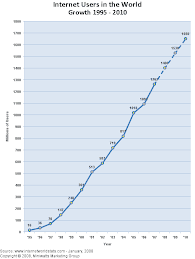
The internet, we all know how to use it, and most probably we feel comfortable surfing the web. Every day, this is becoming a reality for more and more people all over the globe. According to Internet World Stats, the number of internet users has grown more than 901 millions in the last 8 years. The percentage of world population using the WWW changed from .4% in 1995 to 23.3% in 2008. The internet growth has been exponential and it is expected to continue with this tendency.
First came web 1.0, and we were able to communicate literally from Mexico to China in a couple of seconds. Similarly we could enter web pages from anywhere in the world and huge amounts of information were available. Later on came web 2.0 and the word community grew sky high. Common users explored the idea of making their own web pages, creating podcasts and videos, sharing knowledge, experiences, and ideas.
The internet has transformed our way of life, or maybe we can say that it has become a way of life for itself. So we have the internet growing by millions every year which means a whole lot of people sharing information and a whole lot of business opportunities. In these days we have multimillionaire companies working completely on the internet, like e-bay or Google.
The links of information that the internet gives us can be a double edge sword. Companies can reach many people but they can also be affected negatively by that same people. For example blogs, every one can right good or bad things about anything. So if a costumer gets a bad experience in… lets say a restaurant, that costumer can write it on the web creating new problems for the restaurant. You better treat your costumer as they deserve…
As the internet evolved through time, so has the surfer and now, as Jakob Nielson (Web usability consultant) discover, they have become “more ruthless”. They don’t have time to waste; they just want to complete the task and then leave as quickly as possible. The loading times is also a problem, in few words web users are not patient.
Same history with e- advertisements, as Greg Stuart pointed out in his article “
What if the Consumer Hates Your Product?” surfers really dislikes advertising on the web. According to his article and to a survey run by Vizu Answers 56% said that they would like to eliminate advertising. 48% said that e-ads are the most irritating ones…
The internet and the e marketing is a door to new opportunities but also new challenges. It is the role of e- marketers to find an effective solution to these obstacles.

Another satisfied costumer...